
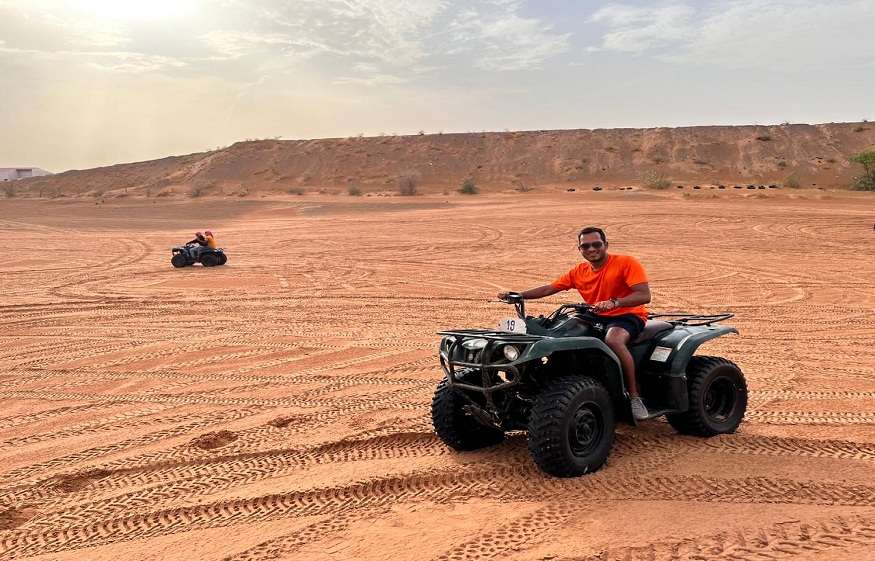
A desert safari in Dubai is often described in simple terms — dunes, rides, sunset, dinner, return.
But that description misses what actually happens when you step into the desert.
Because the moment the city disappears behind you, the experience stops behaving like a tour and starts behaving like a system that is constantly changing while you are inside it.
The desert is not a location you visit.
It is an environment that resets itself while you are still experiencing it.
And that is what makes it so difficult to explain — and so impossible to forget.
Why the Desert Feels Like It Has Its Own Logic
At first glance, the desert looks empty and uniform.
But once the vehicle moves deeper into the dunes, that illusion breaks quickly.
Sand behaves differently from anything most travelers are used to. It shifts under pressure, collapses at edges, hardens in patches, and softens again depending on wind exposure and heat. Even footprints don’t stay permanent.
During a desert safari Dubai journey, travelers start noticing something unusual:
the same direction never feels the same twice.
A dune that looked smooth from afar suddenly becomes steep. A slope that seemed easy turns unstable halfway through. The landscape keeps rewriting itself in small, almost invisible ways.
That’s when the desert stops feeling passive.
It starts feeling responsive.
Why Movement Inside the Desert Feels Like Controlled Uncertainty
A desert safari is built on movement, but not the predictable kind.
When vehicles begin off-road driving, especially during dune bashing, the experience shifts into a pattern that feels unstable but controlled at the same time.
The SUV climbs a dune that blocks the entire horizon.
Then drops into soft sand that absorbs motion unexpectedly.
Then drifts sideways as the surface gives way under pressure.
Nothing follows a straight logic because the terrain itself refuses to stay consistent.
Drivers constantly adjust:
- momentum based on sand resistance
- angle based on dune curvature
- speed based on slope softness
- direction based on surface behavior
To passengers, it feels like unpredictability.
To skilled drivers, it is reading a constantly changing surface in real time.
That gap between perception and control is what creates the intensity.
Why the Desert Makes Time Feel Structurally Different
One of the most overlooked parts of a desert safari is how time behaves inside it.
Not literally — but perceptually.
In cities, time is structured by signals, buildings, and schedules. In the desert, those reference points disappear. There are no fixed landmarks passing at regular intervals. Only dunes repeating in different shapes.
As a result, the brain stops measuring time in minutes and starts measuring it in moments:
- a sudden climb
- a silent pause on top of a dune
- a long drift across soft sand
- a shift in light across the horizon
This fragmented perception is why safaris often feel shorter or longer than expected. The experience is not linear. It is event-based.
Why Dune Bashing Feels Like the Desert Is Testing Reaction Instead of Speed
During dune bashing, the most surprising realization for many travelers is that speed is not the main factor.
Control is.
The desert creates situations where acceleration alone does not solve anything. A steep dune requires timing, not force. A soft patch requires momentum, not pressure. A sharp descent requires restraint, not aggression.
So the experience becomes less about driving fast and more about responding correctly to terrain behavior.
This is where the desert feels almost like it is “testing” movement decisions.
Not in a dramatic way — but in a physical, immediate way where every action produces a reaction from the environment.
That interaction is what defines the experience.
Why Quad Biking Changes the Relationship Completely
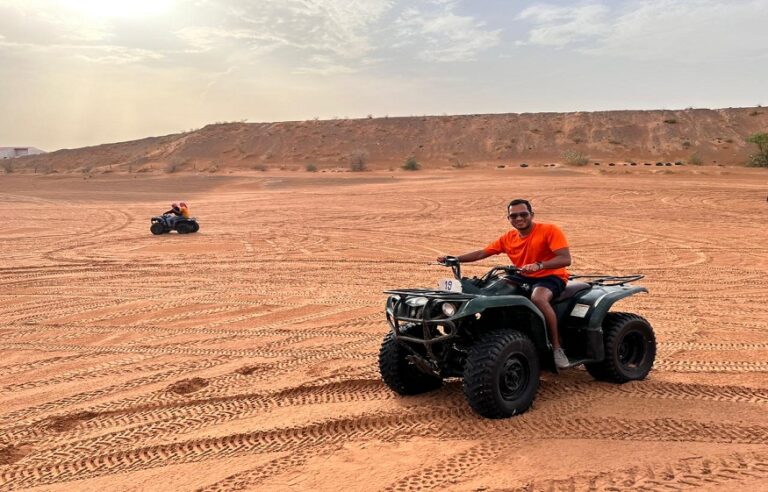
When travelers switch to a desert safari with quad bike, the structure of the experience changes again.
Now the response loop is direct.
Instead of observing how a vehicle reacts, the rider becomes the one adapting to the desert in real time. The quad bike responds instantly to:
- sand depth
- throttle pressure
- directional shifts
- dune angles
This removes the layer of separation that exists in SUV-based driving.
The desert is no longer interpreted through a driver.
It is interpreted through the rider’s own balance and control.
That is why quad biking often feels more personal — not because it is more extreme, but because it removes distance between action and response.
Why Luxury Safaris Change the Quality of Perception, Not the Activity
A luxury desert safari Dubai does not fundamentally change the desert activities.
It changes how uninterrupted they feel.
When crowd density is reduced and routes are spaced out, the desert stops feeling shared and starts feeling open again. There is less visual interference, less noise overlap, and more continuity between experiences.
That continuity matters more than people expect.
Because in the desert, interruption breaks immersion instantly.
Luxury setups focus on preventing that:
- smoother activity transitions
- wider spacing between vehicles
- controlled timing for sunset phases
- quieter zones for viewing and rest
The result is not a different desert — but a clearer version of it.
Why the Desert Feels Different After You Leave It
One of the most unusual effects of a desert safari is what happens after it ends.
When travelers return to the city, the contrast becomes immediate.
Structured roads feel more rigid. Noise feels more concentrated. Space feels compressed.
The desert, by comparison, feels like an environment that operated under completely different rules — where movement, silence, and distance were not constrained in the same way.
This contrast is what makes the memory stick.
Not the activities alone — but the shift in perception they create.
Final Thoughts
A desert safari is not defined by what happens on the surface.
It is defined by how the environment behaves while you are inside it.
The desert does not remain static. It shifts, responds, and reconfigures itself in ways that make every moment slightly different from the last.
Whether through dune bashing, immersive desert safari with quad bike experiences, or structured luxury desert safari Dubai journeys, the core experience remains the same:
You are moving through a landscape that does not stay the same while you are moving through it.
And that is what makes it impossible to replicate — and even harder to forget.




+ There are no comments
Add yours